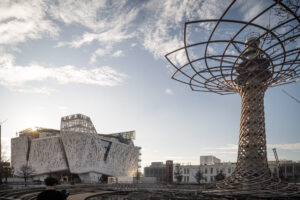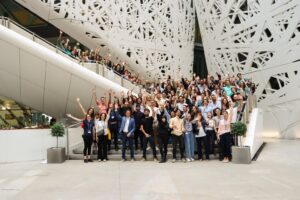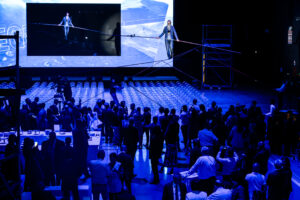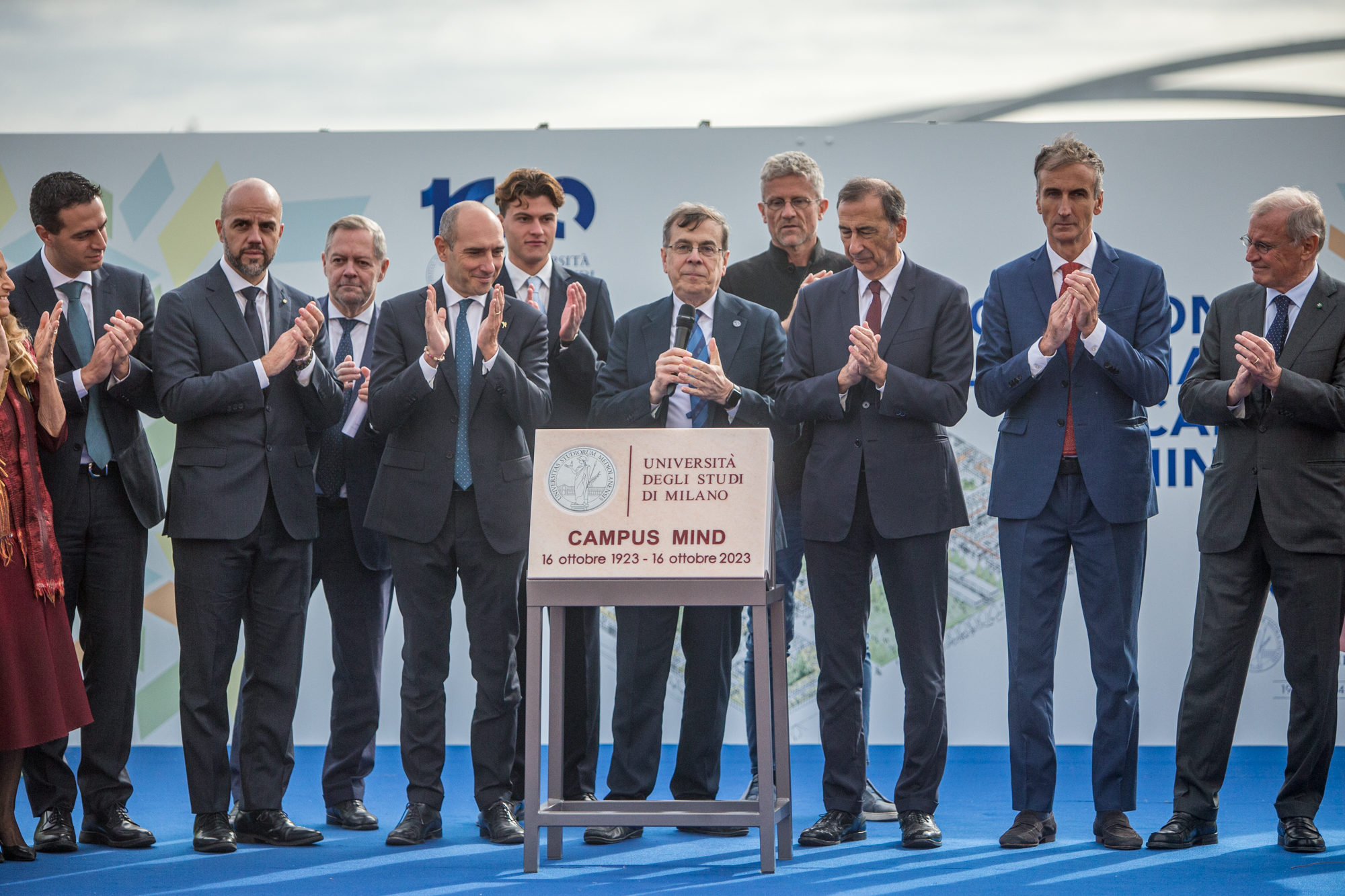
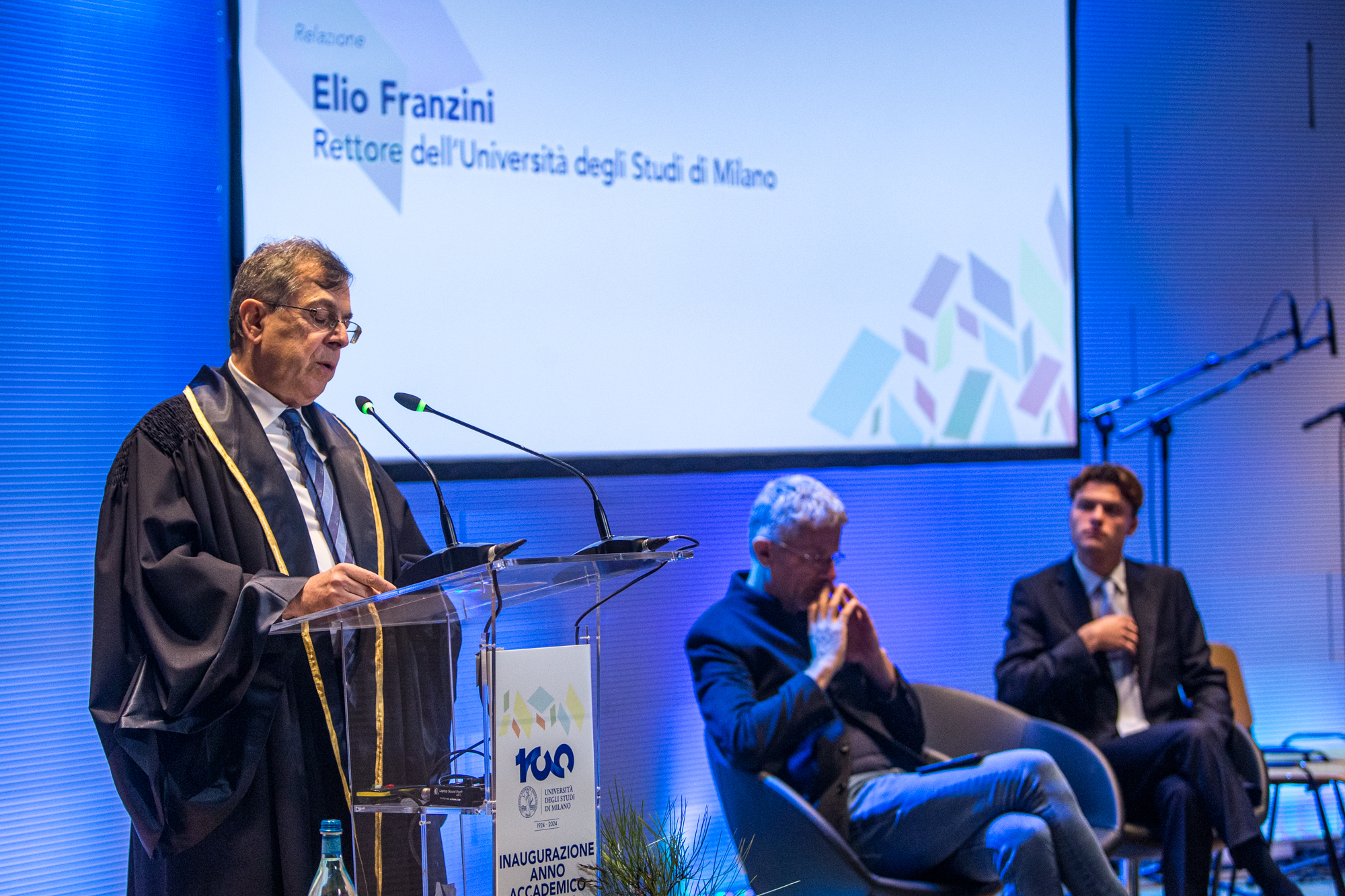
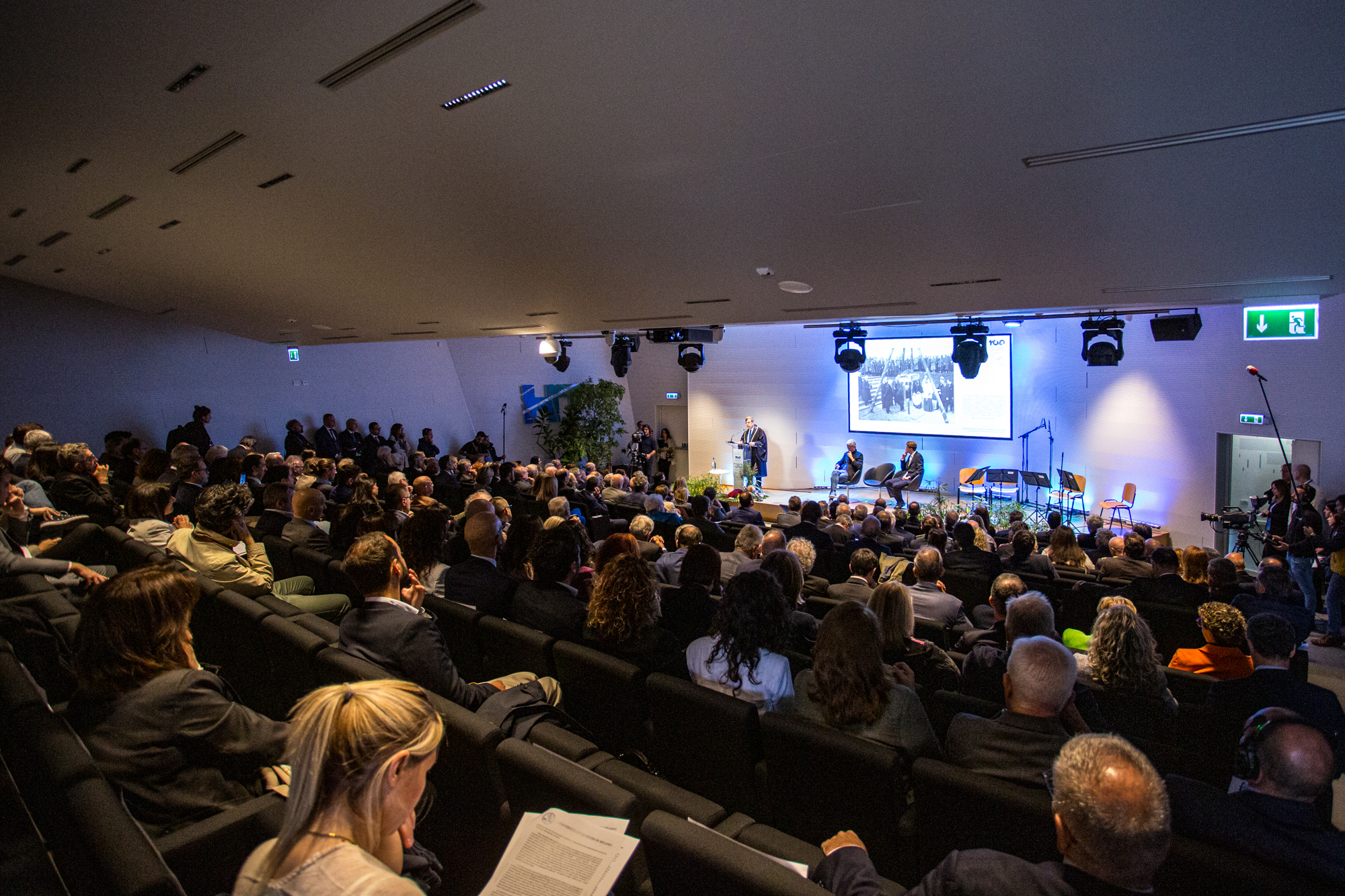
Milan, October 16, 2023. The inauguration ceremony for the academic year at the University of Milan took place in the Auditorium of Palazzo Italia, in an atmosphere of great excitement. Before its history at Mind, the inauguration was preceded by the ceremony to unveil the first stone of the new campus, a slab of Candoglia marble. In attendance were: Rector Elio Franzini, Undersecretary to the Prime Minister Alessandro Morelli, Advisor to the Minister of University and Research Cristina Rossello, Lombardy Regional Councilor for University, Research, and Innovation Alessandro Fermi, Prefect of Milan Renato Saccone, Mayor of Milan Giuseppe Sala, Mayor of Rho Andrea Orlandi, Monsignor Luigi Bressan, Lendlease Europe CEO Andrea Ruckstuhl, Arexpo S.p.A. CEO Igor De Biasio, MIT Senseable City Lab Director and author of the architectural vision for the MIND Campus Carlo Ratti, Vice Rector Mariapia Abbracchio, and President of the Student Conference of the University of Milan Elia Montani.
The value of symbols is the common thread running through the day: symbols chosen to unequivocally establish the identity of a transformation that aims to enhance the link with history, with memory, with the deepest identity of the State.
The Candoglia marble chosen for the groundbreaking ceremony of the Campus in Mind, a constituent element of Milan Cathedral, generously donated by the Veneranda Fabbrica, represents the university's ongoing dialogue with Milan, but also underlines its perfect continuity with its origins. In fact, the first stone of the Città degli Studi (City of Studies) in Cascine Doppie in 1915, which after eight years of activism by Mangiagalli would become the University of Milan, was also made of Candoglia marble.
A neighborhood that the State University has chosen not to abandon, despite the relocation of almost all of its scientific components to Mind. On the contrary, it has decided to enhance it, confirming its university vocation with the recent start of construction of the new humanities campus.
The date is the culmination of the symbolism that accompanies this historic day: October 16, 1923, marks the founding of the State University, exactly one hundred years ago today, and the two dates are engraved on the Candoglia slab, which will become an iconic feature of the new Campus.
At the end of its centenary, after a long journey, the State University arrives in Mind, where a scientific campus will be developed that will take it into the future, but within a framework of multipolar growth for the university that pays homage to its history, as well as a choice of development that respects its multidisciplinary vocation and the social and cultural value of its settlements in the area.
A vision of the future—developed and concretely launched—that is the legacy of Rector Elio Franzini and which is naturally at the center, expressed with different emphases, even in the last inaugural speech of his term.
The fate of the rectors of the State University, starting with the first, Mangiagalli, is to have to find new spaces, Franzini begins: "Those who lead universities and have the public good, the interests of students, research, teaching, and healthcare at heart must always consider the construction of new spaces as an essential goal." The MIND Campus was born "from the intuition of my predecessor Luca Vago and will continue with those who come after me, enjoying the possibilities that different visions can offer," even if, as the Rector points out, "although there are names at the helm, Mind, such as Città Studi or the magical reconstruction of Ca' Granda after the bombings, are not only the result of those leaders, but the result of thousands of women and men who, whatever their role, have truly built'. This passage allows the Rector to renew his thanks—and to express his "unquenchable nostalgia"—for "everyone, absolutely everyone, (...) essential to the growth of an institution," a "parity" that Franzini refers to as "a legacy of my years that can be respected."
The Rector chooses not to dwell on the positive data, which testify to a growing university (see attached sheet) – "preferable, when leaving, not to do, to put it in Milanese terms, the bauscia" – but briefly mentions the problems that remain unresolved for the Italian university system: the lack of resources – insufficient primarily for the right to study – the persistence of procedures that make "the public sector rigid and fearful," and the precarious nature of research, on which he is quite clear: "Uncertainty does not sharpen the mind, it consumes it, and we must take into account the rights of our researchers and, above all, our young female researchers."
As always, Franzini dedicates the heart of his speech to the students, recalling the need to "give them a future that offers greater opportunities, both in terms of housing and education, because, let us not forget, they are the ones who bring the world to life, who generate incessant value." The Rector quotes John Paul II, renewing his invitation not to be afraid, "first and foremost of their own youth," and again Mangiagalli, who in his first inaugural speech defined students as bearers of an "intense breath of freedom" in a university that must remain open, Franzini comments, to every "encounter and clash of ideas."
This definition is in line with the idea of the University that emerges from the words of the Rector: especially in a world "ravaged by the madness of war," it is the duty of universities to "build peace through education, dialogue, and the sharing of cultures." The university must be "increasingly open to the world, to diversity, to difference (...) because history has thrown reason, unilateral truths, and closed ideologies into crisis and has revealed worldviews in which freedom and justice are not already acquired possessions but ever-new horizons to be reconquered."
In keeping with the deeply multidisciplinary identity of the University, the Rector reminds us that knowledge "must always be renewed, not by reproducing an abstract eternity, but by using it to build a system of civil and social values. A single vision destroys it, turning its depth into fragile simulacra." The university, on the contrary, is "the multiplication of perspectives, the crossing of disciplines to keep their cognitive depth alive." Thus, mirroring this, it is an "infinite complexity, lost in countless paths" that emerges when one attempts to construct a single history of our University, a single genealogy.
The Candoglia marble base returns at the end of the Rector's speech: an icon of our history which, together with our history, "will bring color to these places." If the University is "the ongoing construction of individual and collective dignity," Franzini concludes, "research, innovation, and reflection are the way to establish, to continue, to lay every day, and always anew, a new stone, beyond people, but with people."
Elia Montani, President of the Student Conference, made a strong statement emphasizing the urgent need for universities to rethink their approach. Universities must respond to the "anthropological challenge we face," the need to foster the growth of "individuals capable of experiencing the human condition on a global scale and promoting an understanding of complexity." Reiterating the centrality of the educational role of universities, Montani denounces what he calls "an incomprehensible antithesis between training and the organizational model that follows from it on the one hand, and education on the other. As if focusing on educating the so-called human capital of our future caused a weakening in terms of knowledge, skills, and research. As if it were really possible to separate the specific training of students from their growth in educational terms."
The challenges that await us, on the contrary, require synthesis, "they cry out for individuals who are more aware and responsible for their role in society; who are curious and attentive to reality and its evolution; who are protagonists with a broad overview."
The Statale Campus at MIND
The creation of the Statale Campus at MIND is part of a comprehensive multipolar development project for the university, which also includes the redevelopment and repurposing of Città Studi, where construction has just begun on the new campus, which will be primarily dedicated to the humanities for that hub, the Central Hub, which is centered in the wonderful Ca' Granda building, the Veterinary Campus in Lodi—also designed by a renowned international architect, Kengo Kuma—and the UNIMONT Campus in Edolo (BS), where the University of the Mountain's courses and scientific activities are based.
Like Mangiagalli's vision of providing Milan with a university worthy of its status, the MIND Campus is an ambitious, wide-ranging project with international scope. As Rector Elio Franzini recently pointed out, it is a project "for the city, for the region, for the entire country."
The project to build a new science campus at MIND began in 2015, inspired by the opportunities offered by the spaces and infrastructure created for EXPO 2015. It addresses the urgent need for a major renovation—in line with the highest international standards—of the scientific facilities that have been housed in Milan's Città Studi district since the early 1900s.
This historic change will propel the University of Milan into the future, allowing it to concentrate its wealth of multidisciplinary scientific expertise in a single location, enhancing internal synergies and interaction with the local ecosystem, thanks in part to a state-of-the-art technological macro-platform available for national and international collaborations. Following a complex process of defining the various aspects of the project, which involved the university and all public institutions at city, regional, and national level, the Campus Project will receive final approval in 2022.
The overall architectural vision for the MIND Campus comes from the international design and innovation studio CRA-Carlo Ratti Associati: "Italian universities, together with their British counterparts, have played a key role in defining the spatial paradigm of places of learning. Much of that paradigm, which is almost a thousand years old, remains valid. However, today, partly due to the changes in social networks generated by the digital revolution, we need something more. We must think of our universities first and foremost as places of encounter and exchange. The physical space must encourage social interaction, favoring a laboratory approach over that of lectures. These considerations gave rise to the architectural vision and guidelines for the new MIND Campus, starting with an open ground floor and an uninterrupted public space that allows teachers and students to meet. Furthermore, nature is able to enter the building, which in turn connects to the landscape," explains Carlo Ratti.
The tender for the construction and 30-year management concession of the Campus, within the framework of the project finance formula, was won by Lendlease. "The construction of the new science campus of the State University in MIND is an exemplary case of public-private partnership for the development of educational infrastructure in the country. At the same time, it is a milestone in the urban regeneration of this area," comments Andrea Rucksthul, CEO of Lendlease Europe. "This kind of collaboration could lead to positive developments if the PNRR programs for regeneration and training were to communicate with each other, also completing the training offer with ITS, which still has around €1 billion unspent, but above all still unallocated in the method. Operators such as Lendlease can do a lot for the country's growth by building infrastructure for training and research: the MIND ecosystem is proof of this."
The land on which the Campus will be built, covering an area of 65,000 square meters, is the subject of a purchase agreement signed with Arexpo in June, following a resolution by the Board of Directors of the University. "The start of construction of the UniMi Campus at MIND is the best demonstration that the innovation district envisioned by Arexpo was a winning choice for the area that hosted Expo 2015, for Milan, for Lombardy, and for the entire country. We are developing a project dedicated to research and innovation that will best address the challenges of the future with the presence of many young people, students, and researchers, and which, thanks to the joint commitment of institutions, universities, and public and private entities, is already a benchmark of excellence on the international scene," said Arexpo CEO Igor De Biasio.
By promoting exchanges between the University and the international scientific organizations already present at MIND, the new Campus will attract talent and drive the development of basic research into concrete applications, with significant national and international social impact. Numerous collaboration agreements have already been signed between the university and various scientific, cultural, and social innovation organizations in the district, including Human Technopole, the new IRCCS Galeazzi-Sant'Ambrogio Hospital, Federated Innovation, Valore Italia, Cascina Triulza, and many others.
"It is an honor to host the inauguration of the 2023/2024 academic year of the University of Milan in the auditorium of the Human Technopole Foundation in the heart of MIND, the Milan Innovation District. Seeing the first stone of the University's future campus laid at the very moment of its centenary celebration is a testament to a cutting-edge scientific institution eager to foster the connection between academic knowledge, applied research, and innovation. The University's presence at MIND will certainly herald important projects and collaborations for the local area and the country. I wish all the students, teachers, and technical and administrative staff of the University of Milan a successful academic year full of new discoveries," concludes Gianmario Verona, President of the Human Technopole Foundation.
Campus figures
The MIND Campus will host a community of over 23,000 people, including students, researchers, teachers, and staff, definitively marking MIND's scientific and international vocation. The Campus will offer a range of commercial activities, services, and spaces for rest, study, and leisure for the community living on Campus, and will be a place for exchange and interaction between Campus users and those involved in activities in other areas of MIND. A true campus built with students in mind, modeled on the most advanced international campuses. We are talking about 18,376 square meters for teaching, for a total of 11,500 places, 62,988 square meters of educational and scientific laboratories, including the 15,000-square-meter macro-platform that will host up to 300 researchers, with highly specialized technological and instrumental infrastructure, 8,546 square meters of library space open to students and citizens, with a total of 1,700 seats, 1,100 beds in residential facilities, 400 of which are reserved for students receiving scholarships, and 5,500 square meters of green space to be used as a botanical garden. The total area of the new campus will be 210,910 square meters.